
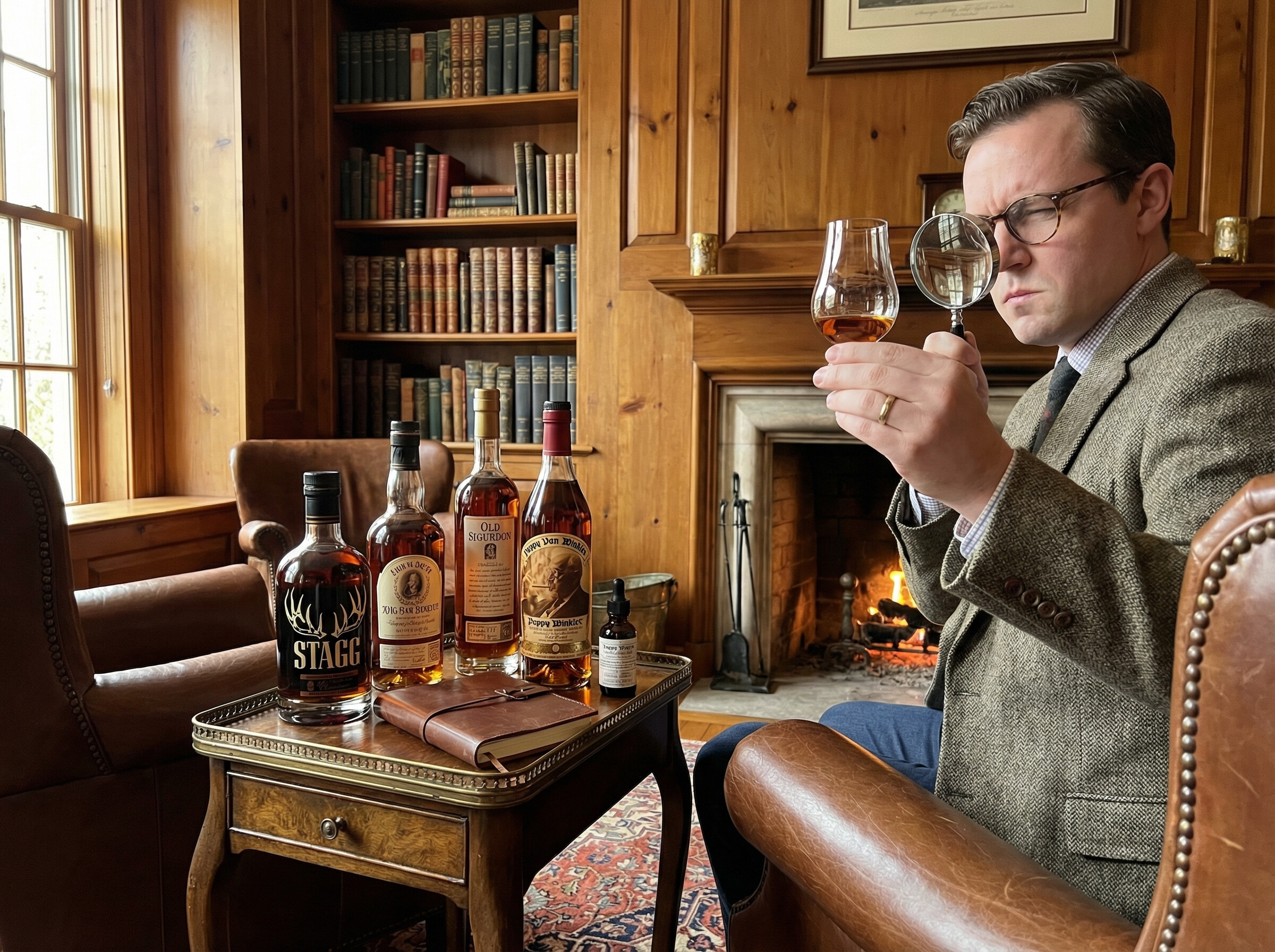
A Completely Serious Guide for People Who Swear They’re Not One
I didn’t set out to become a bourbon snob. I really didn’t. Like most people, I started with a basic bottle, a couple of ice cubes, and zero opinions about mash bills, chill filtration, or warehouse locations. Bourbon was just something you drank at the end of the day to unwind. Simple. Honest. No fuss.
Then one day, someone handed me a Glencairn glass instead of a rocks glass and asked what I was “getting on the nose.” That was the moment everything changed.
If you spend enough time around bourbon, whether tasting, collecting, reading labels, or hanging out with other enthusiasts, snobbery has a funny way of sneaking up on you. It doesn’t arrive loudly. It shows up quietly in your vocabulary, your buying habits, and the way you subtly judge other people’s pours.
So, in the spirit of self-awareness and a little fun, let’s talk about it. If you follow the steps below, you too can become a full-fledged bourbon snob. Or at least recognize some uncomfortable truths about yourself along the way.

Step One: Stop Calling It “Whiskey” (Unless You’re Educating Someone)
The first sign of bourbon snobbery is linguistic. You no longer say “whiskey” unless you’re speaking broadly or correcting someone. Bourbon is bourbon. Rye is rye. Scotch is Scotch. Precision matters now.
If someone says, “I like whiskey,” you smile politely and ask, “What kind?”
If someone says, “bourbon whiskey,” you gently explain that bourbon is a type of whiskey, but not all whiskey is bourbon. You might even quote the legal definition if the mood strikes.
This is where you start to feel smarter than you were before. It’s subtle, but it’s there. Words have meaning, and you now know which ones matter.
Step Two: The Neck Pour Is No Longer a Drink, It’s a Theory
At some point, you stop judging a bottle based on the first pour. You start talking about the neck pour like it’s a scientific phenomenon.
“This one really opens up after a week.”
“Give it some air.”
“The neck pour doesn’t represent the bottle.”
You say these things with confidence, even though you probably didn’t think about oxygen exposure two years ago. Now, if someone says they didn’t like a bottle after their first glass, you immediately ask how long it’s been open.
You’re not being dismissive. You’re being helpful. At least that’s what you tell yourself.
Step Three: You Can No Longer Just Say “This Is Good”
This might be the most dangerous stage.
You’ve tasted enough bourbon that “good” no longer feels sufficient. You start describing flavors in ways that would confuse your past self. Notes of caramelized brown sugar. Toasted oak. Baking spice. Leather. Tobacco. Old books. Campfire vibes. Nostalgia.
If someone says, “It tastes like bourbon,” you nod, but deep down you’re thinking, That’s not wrong, but it’s not helpful either.
You’re not showing off. You’re just expressing what you experience. But somehow your descriptions keep getting longer, and the glass keeps getting swirled more aggressively.
Step Four: Proof Matters More Than You’d Like to Admit
Early on, proof was just a number. Now it’s a benchmark.
Eighty proof is fine, but it’s thin.
Ninety proof is respectable.
One hundred proof feels correct.
Barrel proof feels like truth.
You don’t refuse lower-proof bourbon outright, but you definitely comment on mouthfeel. You say things like “watered down” and “lacking structure.” You start assuming chill filtration is involved if the flavor doesn’t hit hard enough.
You might even tell yourself you prefer higher proof because it delivers more flavor. Which may be true. Or it may just make you feel like you’ve earned your stripes.
Step Five: MSRP Becomes Part of Every Conversation
A true bourbon snob doesn’t brag loudly. That would be gauche. Instead, they mention price casually, as if it just came up organically.
“I was lucky to get it at MSRP.”
“Secondary pricing has gotten ridiculous.”
“I wouldn’t pay over retail for that one.”
You might say this even when no one asked. Especially when no one asked.
Knowing the suggested retail price of a bottle is now part of your identity. Overpaying feels like a personal failure. Underpaying feels like a quiet victory you want to share without sounding like you’re sharing it.
Step Six: You Use the Word “Allocated” Correctly and Often
This is the final stage.
You know the difference between limited release, allocated, store pick, and unicorn bottle. You understand distribution. You know that availability depends on the market. When someone says Buffalo Trace is impossible to find, you smile and say, “It depends where you live.”
You have opinions about hunting bottles. You know which stores get drops on which days. You might even claim you don’t chase bourbon anymore while casually checking release calendars.
This is when you realize you’re fully in it.
Why Bourbon Snobbery Happens
Here’s the truth beneath the satire. Bourbon snobbery usually comes from enthusiasm, not arrogance.
People learn more. They taste more. They invest time and money into the hobby. With knowledge comes opinions, and with opinions comes judgment, sometimes unintentionally.
Bourbon is also a culture. It rewards curiosity. It encourages comparison. It invites storytelling. Somewhere along the way, it becomes less about the drink and more about the experience around it.
That’s not a bad thing. It only becomes a problem when it stops being fun.
Bourbon Snob FAQ
What is a bourbon snob?
A bourbon snob is someone who has gone past casual enjoyment and into the world of strong opinions, detailed tasting notes, and very specific preferences. It usually starts with genuine curiosity and turns into snobbery when enjoyment quietly becomes judgment. Most bourbon snobs do not think they are bourbon snobs, which is often the biggest clue.
Is being a bourbon snob a bad thing?
Not necessarily. Knowing more about bourbon can make the experience more enjoyable and help you discover what you truly like. It only becomes a problem when it takes the fun out of the drink or makes others feel uncomfortable for liking something different. Bourbon should bring people together, not create a hierarchy at the bar.
Do I need expensive or allocated bottles to be considered a bourbon enthusiast?
Absolutely not. Plenty of great bourbons are affordable, widely available, and consistently enjoyable. Allocated bottles can be fun to hunt and try, but they are not a requirement for appreciating bourbon. Anyone who says otherwise may be drifting into snob territory themselves.
Does higher proof always mean better bourbon?
Higher proof often means more concentrated flavor, but that does not automatically mean better. Some bourbons shine at lower proofs, especially for casual sipping. Preference matters more than proof, even if it is tempting to believe that barrel proof equals superior taste.
Why do bourbon drinkers talk so much about neck pours and letting bottles open up?
The idea behind the neck pour is that oxygen exposure can slightly change how a bourbon tastes over time. While this can be real, it is also sometimes used as an easy explanation for why someone did not like a first pour. At the end of the day, if you enjoy it now, that is what matters most.
How can I enjoy bourbon without becoming a snob?
Focus on what you like, not what is popular or hyped. Drink bourbon the way you enjoy it, whether that means neat, on ice, or in a cocktail. Be curious without being critical, and remember that everyone’s palate is different. If the conversation ever feels more competitive than fun, it might be time to refill glasses and change the subject.
Confessions of a Recovering Bourbon Snob
Now for the honest part.
I’ve said all of these things. I’ve thought most of them. I’ve corrected people when I probably didn’t need to. I’ve overanalyzed pours that were meant to be enjoyed casually. I’ve let hype influence expectations more than once.
And yet, the moments I remember most aren’t about tasting notes or proof points.
They’re about sharing a bottle with friends. Discovering a great pour unexpectedly. Enjoying a simple bourbon on a quiet evening without dissecting it. Remembering that bourbon, at its core, is meant to be enjoyed, not auditioned.
If you see yourself in this list, welcome to the club. You’re among friends. Just remember to keep a sense of humor about it. The best bourbon in the world is still the one you enjoy drinking, whether it’s allocated, barrel proof, or poured over ice in a chipped glass.
And if someone calls it “whiskey,” maybe just smile and pour them another glass.
At the end of the day, bourbon isn’t a test you pass or a club you earn your way into. It’s a drink meant to be shared, enjoyed, and sometimes overanalyzed just enough to make the conversation interesting. If you catch yourself slipping into snob mode now and then, that’s okay. Most of us do. Just remember that the best pours usually come with good company, an open mind, and absolutely zero need to prove anything to anyone.
About Jim
Jim is the creator of Dram Discoveries, a blog dedicated to exploring and celebrating the world of whiskey. With over six years of experience, he combines a passion for whiskey’s craft and culture with a love for connecting enthusiasts through tastings, stories, and shared discoveries. For Jim, whiskey is more than a drink—it’s a journey of camaraderie, learning, and lifelong appreciation.